
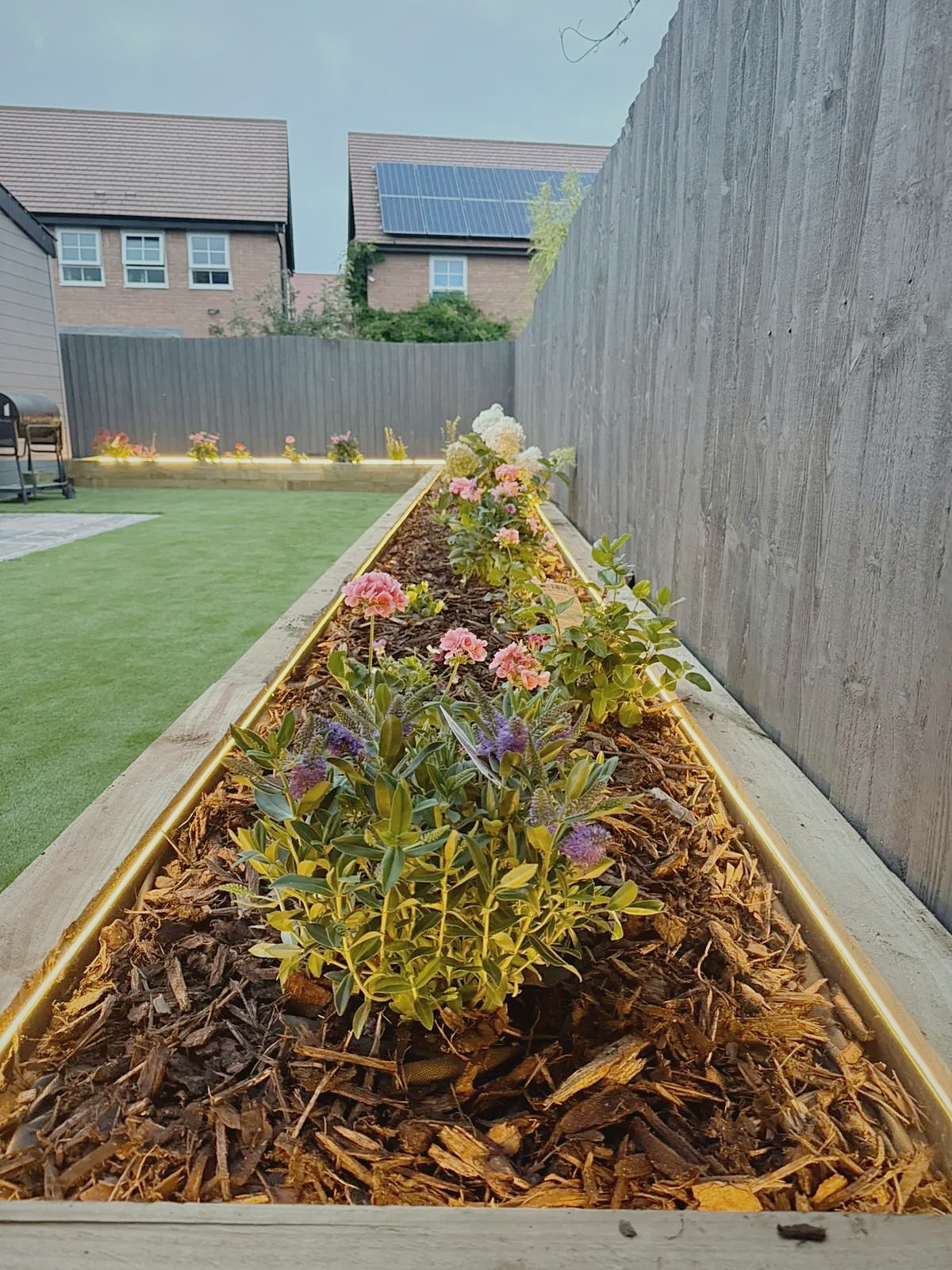
Every light needs a job
Before choosing a single fitting, ask what each light is for. There are only three good answers: helping you move (steps, paths, thresholds), helping you stay (table, seating, cooking), or giving the eye something to enjoy (a tree, a wall texture, planting). A light without one of those jobs is glare waiting to happen. Start with the jobs and the design writes itself.
Layer low, medium and feature light
The gardens that feel magical at night are lit in layers. Low-level washes along steps and bed edges do the practical work. Warm pools of light where people sit make the space feel inhabited. One or two feature moments, like an uplit tree or a lit wall, give depth so the garden doesn't end at the window. Three layers, each modest, beat one bright source every time.
Warm, and dimmer than you think
Colour temperature makes or breaks the mood. Stay at 2700K or warmer outdoors; cool white light makes planting look grey and gardens feel like car parks. Brightness follows the same rule: outside, surrounded by darkness, a little light goes a long way. If you can see the light source itself rather than what it's lighting, it's either too bright or badly aimed.
Hide the source, show the effect
The best lighting is invisible until dark: strips tucked under coping stones, spots recessed among planting, fittings screened by foliage. Glare is the enemy. A fitting that shines into your eyes, or into a neighbour's bedroom window, undoes everything else. Aim light down or across surfaces, never outwards at eye level.
Cable at the build stage, always
The practical heart of this article: lighting is an electrical project, and cabling belongs under the ground, planned before paving goes down. Retrofitting cables under a finished patio means lifting it. Even if the budget defers the fittings themselves, put ducting and cable runs in during the build. It costs little at that stage and keeps every option open later.
Keep it maintainable
Choose fittings you can actually service: sealed units of decent quality, drivers somewhere accessible, and a supplier that will still exist when a unit fails in year six. A premium scheme with unobtainable spares becomes a dark garden. Boring reliability is a design feature.
A simple starting recipe
- Light every level change, softly, for safety
- One warm pool of light where you eat or sit
- One feature, a tree or textured wall, lit from below
- Everything on a dimmer or smart control, warm white only
That modest scheme, wired properly at build stage, will change how often you use the garden more than almost any other single decision.